selected reviews
2025
agree to disagree
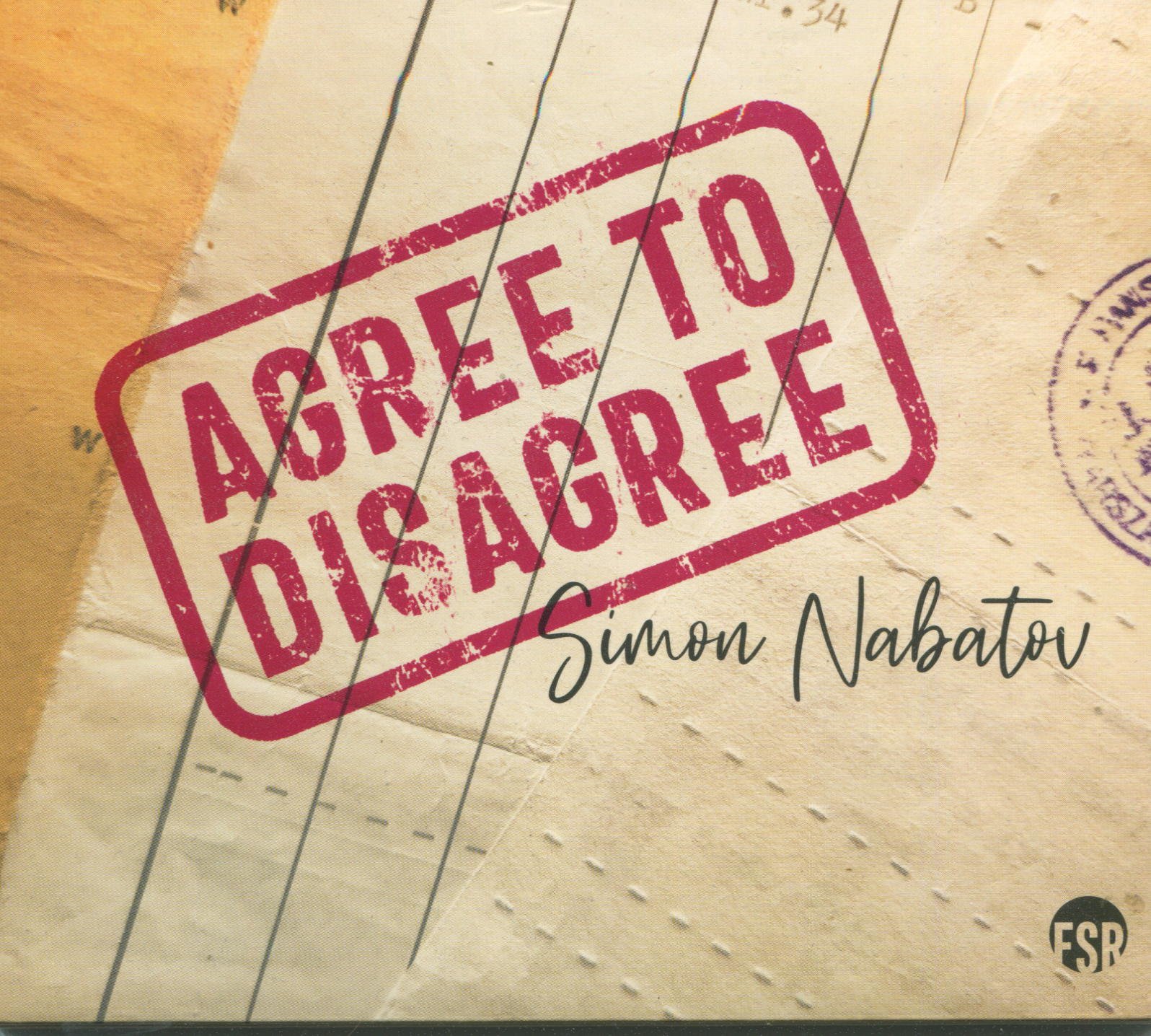
Agree to Disagree is a compelling exploration of musical dialogues and contrasts, composed by pianist Simon Nabatov. Recorded over three days in April 2024 at the Kammermusiksaal Deutschlandfunk in Cologne, the album features eight compositions performed by three distinct ensembles. Each ensemble brings a unique texture and perspective, ranging from jazz quintets to chamber sextets, showcasing Nabatov's versatility and innovative approach to composition and improvisation.
Jazz Messengers
Pianist Simon Nabatov leads three shifting ensembles through eight distinct compositions in this richly orchestrated and stylistically diverse studio recording, blending chamber elements and jazz improvisation with musicians including Angelika Niescier, Shannon Barnett, Pascal Klewer, and Roger Kintopf, as Nabatov explores contrasting textures, political undercurrents, and tonal interplay.
Squidco
Squidco
assemblage
Jazzword
Without sacrificing speedy progress and energetic key pressure, starting with “Upstream “, the first of the dozen tunes that make up this assemblage, Nabatov always hints at the lyricism and groove avoided by Agnel and company. At the same time while there are interludes of scene setting and themes that could have arisen from half-remembered standards, his key clipping as well as double bass string vibrations and drum pops emphasis confirm the personal and distinct scope of the tunes and performances.
Every balladic intimation as on “Daily Sorrows” and “Naive Visitor” is cultivated with a kernel of syncopated toughness in the midst of sensitive expositions. The first tune, which sounds as if it could easily be fitted with lyrics, emphasized supple slides and stops that evolve alongside the melody. Similarly the folksy and formal projection of “Naive Visitor” is undercut with alternating turns towards ragtime-like note jumping, and two-handed keyboard smashes.
Rainey’s collection of cymbal sizzles, woody clanks and snare pitter patter is strictly oriented towards backing piano journeys from presto theme outlines, swing intensity and dramatic patterning. However Helias invests “Uncoil” with thick arco thrusts and splayed pizzicato drones.
Melding elements of swing,, stridency, softness and full keyboard swells, Nabatov plus Helias and Rainey create a notable definition of piano trio Jazz-free improvisation. With more emphasis on the last two words than the first one, Agnel, Edwards and Noble create a divergent and equally valid variation on the trio approach.
–Ken Waxman
2024
dream walks
Jazzword
There’s no such hesitation on Dream Walks however. That because, unlike the other disc where he’s adding landscaping and tuck-pointing to someone else’s architecture, Attias and Nabatov are the only workers here, free to design projects to their own dual expectations. For instance even during “Meshes of Limbo”, the first track, those snuffles and drones which Attias used to add romance to some Monoliths and Screens tracks respond to Nabatov’s keyboard prodding and swiftly convert to altissimo flattement and disconnected shrills that latterly join soundboard rumbles.
Antiphony is also used more frequently, within the two-person strategy of parry and thrust. Fragmenting as well as intertwining reed-keyboard textures are a large parts of the program whether the two are galloping or moving at a moderated pace. Yet at the same time both players ensure that the tracks include a proper horizontal exposition. Subtlety and stress share space, with the narratives often expressing both at various junctures. On the concluding “Stays in Vegas” for instance, controlled dynamics allow the saxophonist to crest with spetrofluctuation only to descend to breathy squeaks and shakes. Simultaneously the pianist’s turn from Slavic romanticism to widening glissandi mirrors these actions in reverse.
Romanticism, ruggedness and reflections are heard throughout these Dream Walks. But there’s no unwarranted recklessness since whether Attias is emphasizing thin shrills, toneless breaths, corkscrewing reed bites up the scale or other extended techniques. Nabatov has the perfect response. Whether it’s occasional inner piano strings strum, emphasis on all parts of the keyboard or nimble chording it fits the reed pattern of time.
Once again Attias has put his skills to good use during notable sideman or duo partner exhibitions.
–Ken Waxman
2023
lovely music
Jazzword
Taking time away from his more ambitious projects such as composing musical suites influenced by modernist Russian literature, pianist Simon Nabatov, who has worked with everyone from Ray Anderson to Gerry Hemingway, has created this exemplar of modern jazz playing and writing. Nabatov, whose path led from Moscow to New York and who now lives in Cologne, recruited three players from that city – saxophonist Sebastian Gille, bassist David Helm and drummer Leif Berger – plus one ringer, American trumpeter Ralph Alessi, to help interpret his nine compositions.
Somewhat of a misnomer if lovely is only defined as charming, the tracks include exquisite arrangements and easy-going narratives, but the sounds are energetic as well as engaging. The only evidence of a ballad is the concluding “No Doubt”, but even there Alessi’s squealing triplets confirm this melody is far from easy-listening territory.
More descriptive are those tunes which match straight-ahead swing with unexpected and ingenious pivots. Juddering horn lines, squeaking string stops, drum shuffles and situated keyboard comping are everywhere. Some pieces are freer still. Dramatic string scrapping on “Nature Morte” for instance underlines a blend of horn harmonies and piano intensity, while on “Timwork” the slippery exposition is swiftly deconstructed with emphasis on harsh sputters and piccolo-elevated brass shakes, although swift reed flutters maintain the composition’s moderated pace.
Still the definition of how loose and open this session is compared to more formal Nabatov work is most apparent on “Old Fashioned”. Anything but the title suggests, the extended pieces gives every player solo space to express himself, revealing expanded techniques from brass note bending to reed flattement to ferocious string pumps, yet without the exposition deviating from focused linear motion and the basic melody.
Although some of the music is lovely by definition, there’s a lot more to this session. It clearly underlines that the skills of the right creator can blend lyricism and invention to produce a program that can be as profound as the most carefully organized musical project without deviating too much from the Jazz tradition.
–Ken Waxman
entangelments
Jazzword
Enhanced textures also characterize the work of another duo, each member of which is an accomplished improviser on an acoustic instrument. Here though, heightening timbres are added from the live electronics used by Russian-American pianist Simon Nabatov. The oscillations’ span suggests the addition of a third instrument to Nabatov’s keyboard on Entanglements (Acheulian Handaxe AHA 2301) recorded with fellow Cologne resident, German tenor saxophonist Matthias Schubert. Free jazz despite the additional voltage, Schubert’s Trane-like tongue slaps, overblowing and siren-like honks are not only integrated into the narratives, but given added oomph when live processed or cushioned by the oscillations. At the same time, Nabatov’s acoustic piano patterns include enough crashing chords and sympathetic plinks to preserve the improvisational aura. “Brushed” is an instance of this as the saxophonist spews out puffs and whines in the form of toneless air blocked by an obstruction in his horn’s bell as Nabatov’s synthesized echoes create percussion backing. Tensile raps are then replaced with keyboard thumps as the saxophonist reed bites and blows out snuffles and split tones. The electronically produced squeaks and air-raspberries however don’t prevent the two from sounding like an expected jazz duo on tracks like “Scratch” The grumbling oscillations have to share space with key clips and clanks and sax buzzes and smears. Squeezing out multiphonics or overblowing an emphasized fruity tone, Schubert then foils the electronics spatial tendency to overwhelm acoustic properties. By the concluding “Closing” the duo confirms the appropriate electro-acoustic balance. A melange of reed growls and tongue stops mixed with crashing piano chords, the flanged wave form variation that are subsequently heard soon dissolve into faint rumbles to make common cause with and accompany the saxophonist’s angled split tone squeaks and a tone-shaking summation.
Ken Waxman
extensions
Jazzword
Taking a break from his ambitious series of program music, Russian-American pianist Simon Nabatov invites five other Köln-based musicians to participate in this two-part improvisation with all of the freedom but none of the formalism of his compositional work. There’s no slackening of sonic invention in this profound group composition however. That’s because the pianist’s ensemble consists of players whose musical latitude is almost a broad as the pianist’s.
The band is multinational as well. Saxophonist Sebastian Gille, who maneuvers between emotional coloration and technical experimentation is German, as is bassist David Holm, who splits arco and pizzicato rhythms and asides with Iranian-German bassist Reza Askari. Trombonist Shannon Barnett, whose strategy encompasses plunger smears and melodic embellishments is Australian, while drummer Mariá Portugal, who prefer subtlety to thundering is Brazilian.
Both tracks roam through multiple interludes. These include hubs of crunching power impelled by dual bass thumps and percussion patterns; dramatic pivots from reed bites to slurs; trombone tongue flutters; and energetic note fanning from the keyboard. Focused horizontal theme development maintains linear consistency while allowing for individual experimentation. However it’s the slightly briefer “Extension 2” which is more suite-like, emphasizing cadenced and compositional shifts throughout.
Introduced a capella by harsh tenor saxophone growls and split tones, the exposition is stimulated to a quicker pace once forearm smashes along the keyboard, thick bass string plucks and irregular reed vibrations are heard. Yet the exposition soon slows down balanced on trombone moans and double bass strums. Nabatov then alters the aural scenery by introducing a processional melody surrounded by basso snarls from the trombonist and smeary vibrations from Gille’s soprano sax as one bassist strums his strings and the other bows asides. By the finale, the theme which the pianist has almost unobtrusively preserved throughout rises above tart brass tongue flutters, reed twitters and sul tasto string scrubs to preserve positioned sound evolution.
In this respite from his program music, Nabatov shows no lessening of his sonic vision. Instead with the freedom expressed by all players, an extension and embodiment of sophisticated group improvising is displayed.
–Ken Waxman
2022
tender mercies
All About Jazz
This collection of seven duets from pianist Simon Nabatov and reedman Frank Gratkowski stands as one of those times when the late Misha Mengelberg's term "instant composition" for a series of seat-of-the-pants encounters makes absolute sense. Perhaps that should not be a surprise, considering the protagonists histories and shared base in the German city of Cologne.
Indeed, their association dates back to at least 1999, when the reedman appeared as part of a quartet on Nabatov's Nature Morte (Leo), but it is an acquaintance which has been renewed numerous times since, not least in a previous duo outing Mirthful Myths (Leo, 2017) and, with the addition of drummer Dominik Mahnig, on Dance Hall Stories (Leo, 2020).
The unison piano and alto saxophone flourishes which start the opening "Turn Of Events" could have come straight off the page. The connection does not fade even as they progress through a succession of different moods: romantic piano interwoven with slightly acerbic alto saxophone; ballad textures; unspooling lines simultaneously twining around one another like plants vying for light; a helter skelter dash, followed by a sudden cooling. Such mercurial escapades are made all the more possible by the pared back format, and the pair make the most of those possibilities on each track.
Gratkowski uncases an arsenal of reeds, switching between alto saxophone, flute, clarinet and bass clarinet, and varying his attack from pure tones to yelps, bleats, susurrations and juddering multiphonics. Nabatov embodies a mountain of technique, but does not let that get in the way of whatever the music needs in the moment. While he revels in independent ideas in each hand, heard to particularly good effect in "Safe Home," he also does not shy away from melody or stylistic markers, such as the near ragtime feel later in the same cut. At times, such a blend of abstraction and accessibility recalls the classic Duets 1976 (Arista, 1976) by Anthony Braxton and Muhal Richard Abrams.
Nabatov and Gratkowski save the most cathartic episodes for the concluding "Disgruntled Settlement," an examination of extremes in which Gratkowski juxtaposes gutbucket bass clarinet blurts with whistles in the bat squeak register, as Nabatov essays lurching blocky bass clusters interspersed with right hand splashes in the treble. Gradually, the pianist excavates a rhythmic figure which at first underpins, then anchors the explosions, until eventually it becomes the basis of a final joint repetition, which supplies the hoped for resolution.
To a tee, it rounds off an album which both dazzles and delights.
John Sharpe
2022
verbs
All About Jazz February 2024
What constitutes a composition? German-based Russian-born pianist Simon Nabatov makes a convincing case that a simple verbal instruction can suffice on Verbs. It is not a claim he makes himself, but the six supposed improvisations each mines such a distinctive seam that, although spontaneously conceived without melody or other formal arrangement, the initial proposition proves enough. Perhaps germane to the achievement is the presence of the pianist's regular trio mates, bassist Stefan Schönegg and drummer Dominik Mahnig, although that is not the whole answer as the date also embraces less regular collaborators in reedman Leonhard Huhn and electronicist Philip Zoubek. In the liner notes the phenomenally talented Nabatov explains that this session fits into a lineage which also includes programs of his works by top drawer Americans such as Tony Malaby, Brandon Seabrook, Chris Speed and Herb Robertson, on releases such as Last Minute Theory (Clean Feed, 2020) and Plain (Clean Feed, 2021). But he also appears as a frequent participant in unbridled formats with partners as varied as reedmen Frank Gratkowski, Michael Attias and Akira Sakata so, in a way, this record acts as a bridge between the two approaches, especially as it contains one of his charts too. It often feels as if Nabatov's piano establishes the guide rails, from the active synthesis of comping, commentary and lead line on the opening "Pray" to the harp-like plucks and percussive taps on "Evolve." That first track is one which could easily pass as preordained, as Huhn's cool poised clarinet interweaves with disciplined but burbling synth and a calm processional vibe from the rhythm team, a mood which remains undisrupted even by the edgy digressions which everyone throws into the mix. Another example of a sustained gambit occurs on "Converge," which begins as a mysterious soundscape of eerie creaks, foreboding chords and indeterminate scrapes, before the parts gradually assume greater definition in a relentless crescendo, as if inexorably looming out of a mist. The final "Float" further demonstrates the group congruence, as jazzy outbursts erupt out of choppy interaction, with Nabatov in particularly sparkling form, while Zoubek's Rhodes-like electronics almost conjure a fusion ambience, even though they never quite settle on an agreed meter. "Breathe," the single written number, also suggests unfettered invention at the outset, though the disconnected series of well-shaped figures emanating from various instruments hint at the existence of a controlling mind. That becomes crystal clear subsequently as the piece rotates through a sequence evoking a big band surge, then an airy Brazilian samba and an outbreak of pointillist improv, almost an album's worth of material in itself. But even without the scripts, the band sets aside ego to pull off intriguing and cohesive results.
John Sharpe
2021
voluptuaries
Jazzword
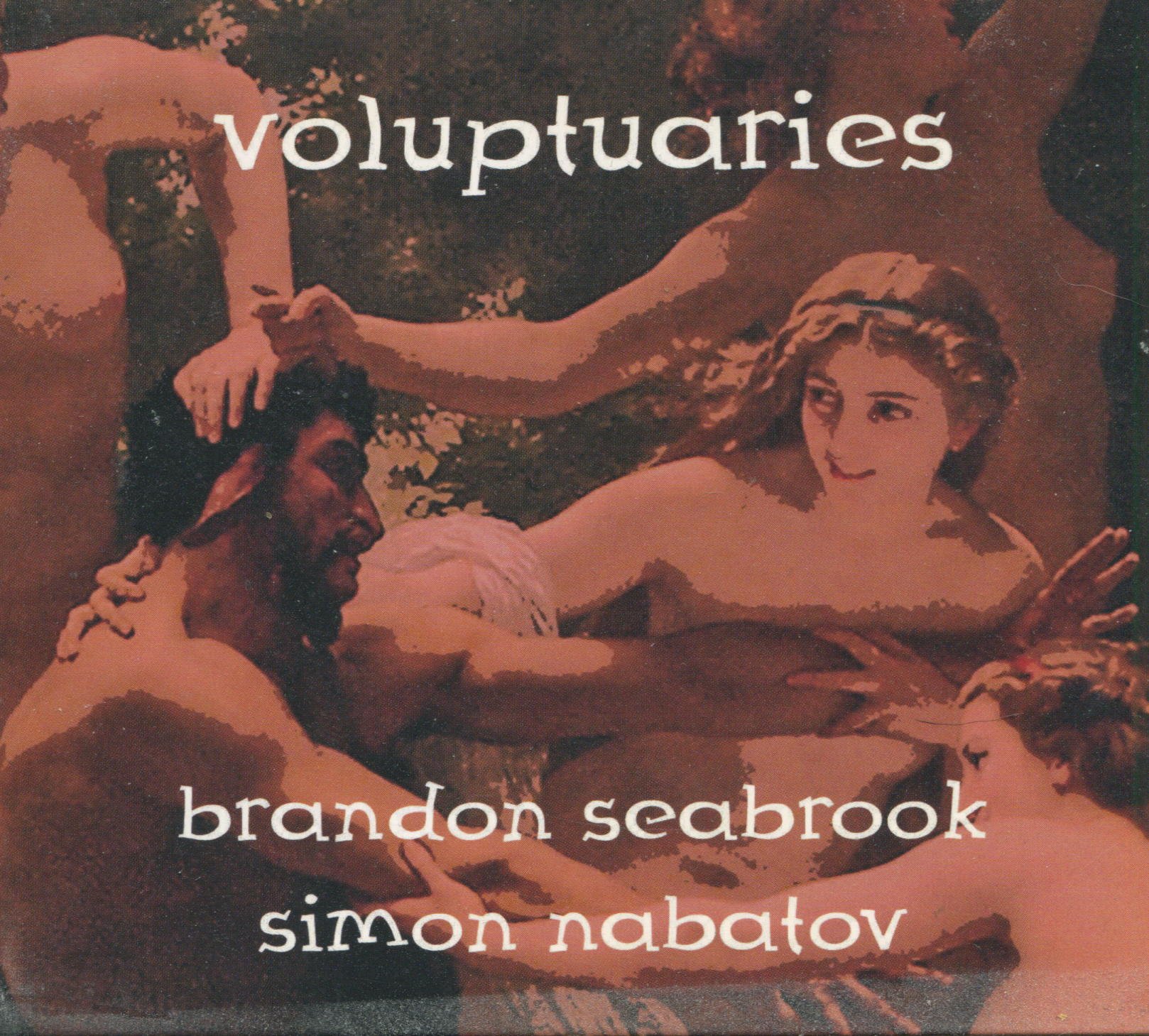
Nabatov, who has played with an encyclopedia’s worth of innovative players in Europe and North America, creates any number of tropes from all parts of the piano and in many pitches and tempos, when matched with a guitarist whose stinging licks and wide-ranging drones are harsher than usual. An uncanny connection, uniform quality is expressed over the entire disc. With most sequences propelled allegro and in tandem, motifs range from the guitarist’s slurred fingering and string swelling are paired with glissandi and inner string slides from the pianist on the introductory “Daggers”. Nabatov’s impressionistic melodic strums mixed with Seabrook’s single-string vibrated decoration enliven the final title track. Slower tracks are more thematic and atmospheric, and include low-pitched correlated textures as well as measured piano note spilling cleaved by ukulele-like snaps or lopped string snaps from the guitarist. Speedier sequences are more adventurous without pointless dissonance. Seabrook projects near-flute like buzzing on “Spirit of the Staircase” for instance that’s subdued by a moderated pattern. While the concluding piano runs on “Fresnel Lenses” use backboard wood-like concussion and soundboard rumbles to challenge barbed guitar picking. Process is coupled with power throughout.
Ken Waxman
brooklyn mischiefs
Jazzword
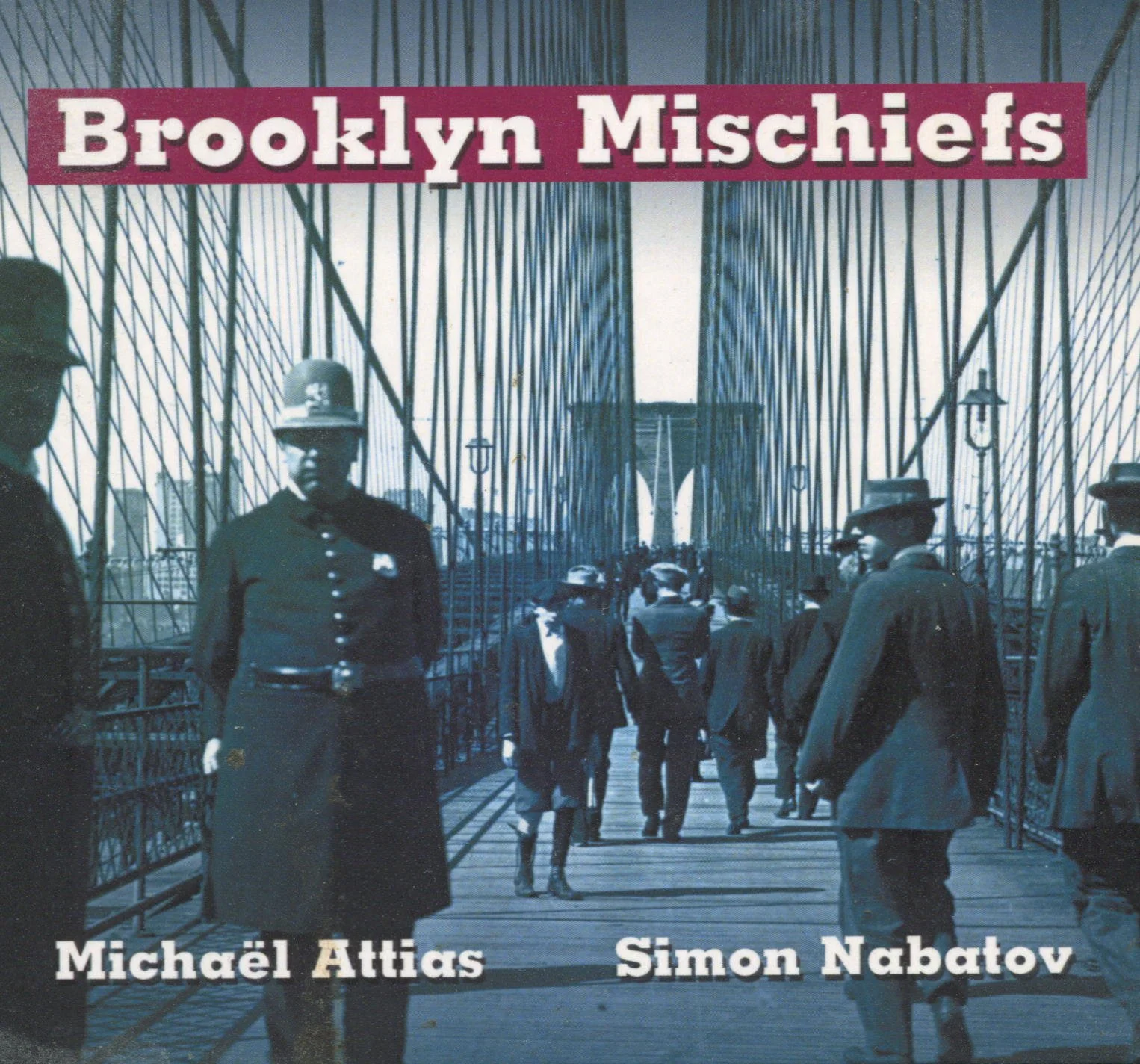
The American alto saxophonist Michaël Attias and Köln-based pianist Simon Nabatov got together in Brooklyn earlier in the decade to see what mischief they could produce during this initial playing opportunity. With each experienced in situations involving innovative players throughout Europe and North America, rapport is established on the introductory “Glimpses & Tangles”. Artfully balanced between Attias’ emphasized trills and Nabatov’s patterning kinetics, the two quickly intensify the duet as Nabatov bangs against the piano wood and jabs the keys, while Attias’ blows deep into the horn’s body tube extracting deep-toned slurs in near tenor-range. Detouring into some Russian romanticism, the pianist still rolls out connective patterning that integrate reed multiphonics into the finale. From that point on the unbreakable connection is made. Inner key rumbles and the occasional melodic delicacy emanating from the piano harp strings become as much a part of the instant compositions as the saxophonist’s focused peeps, irregular vibrations and sharp reed bites. Culmination of the program mixes an improvisation titled “Languid” with Herbie Nichols’ “The Spinning Song” for a seamless 16¼ minutes of ingenuity. Impossible to tell where the improvisation ends and the composition begins, Nabatov and Attias ambulate, mixing flattement buzzes and in-and-out saxophone respiration with slow-paced key rumbles and metal objects vibrating atop the plucked and stopped piano strings. Circular-breathed reed flutters and trills meet thick two-handed keyboard pressure, which eventually leads both to slide down the scale to a distinct, emphasized pattern, which may be the Nichols head. Using connective comping behind bursts of treble melody, Nabatov joins Attias to complete the narrative with a staccato extro.
Chamber Jazz played by only two musicians may be understated and somewhat languid. But pair the right players, and sounds equal to any other program arise, as on the discs here.
–Ken Waxman
2020
time labyrinth
Besides a long history with the pianist, the septet members on Time Labyrinth are also an imposing crew. Shannon Barnett plays trombone; Melvyn Poore, tuba; Matthias Schubert tenor saxophone; Dieter Manderscheld, bass and Hans W. Koch, synthesizer. Frank Gratkowski not only plays alto saxophone, clarinet, bass clarinet and flute, but created the Max/MSP patch seen on every musician’s monitor as digital conductor to preserve the time grid of Nabatov’s exploratory compositions. Although both CDs are undeniably post-modern, descriptions of the processes involved are more formidable than the intriguing music.
The Nabatov session for example moves from an introduction of near silence to create themes which include individual instrumental extensions inside suggestions of moderated menace. Some are moody and layered with the likes of mid-range flute expressions, oscillated buzzes and string resonation that elaborate tones without reaching resolution. A couple such as the extended “Repeated”, spangle an essay in tone suspension with vigorous clarinet trills, piano glissandi and even cornucopia-wide guttural tuba snarls without upsetting the unfolding horizontal action.
While this delicacy can be appreciated the full extent of Nabatov’s skill is better displayed on those tunes which are more energetic than enervated such as “Metamorph” and “Right Off” The first charges out of the gate with a variation of speedy, high volume continuum with horn swoops and flutters, keyboard clicks and later Aylerian, reed-biting screams from Schubert, plunger guffaws from Barnett. However the pianist’s chill exposition prevents a descent into sonic chaos, as a bit of flowery silent-movie-house-like accompaniment is strengthened into pressured clips that join with synthesizer whines for concentrated connections. A 12-tone mash up, “Right Off” works extended pauses into a narrative that otherwise is split between a yearning trombone story telling with deeply felt moderated grace notes and double tonguing and a gradual turn to micro toughness. Granulated telephone exchange-like noises from the synthesizer, reed puffs and hard piano key clipping is finally subsumed into a concentrated exposition from all the players followed by a brief coda of downwards squirming piano lines.
With the final “Choral” cleverly arranged so that this piano showcase frames the showy-to- simple keyboard expressions in undulating pitches, the layer finally separate for an intense alto saxophone solo. With another layered coda that is as much hopeful as it is hymn-like it appears in this context that Nabatov has demonstrated his mature compositional skills.
Ken Waxman
2019
readings - gileya revisited
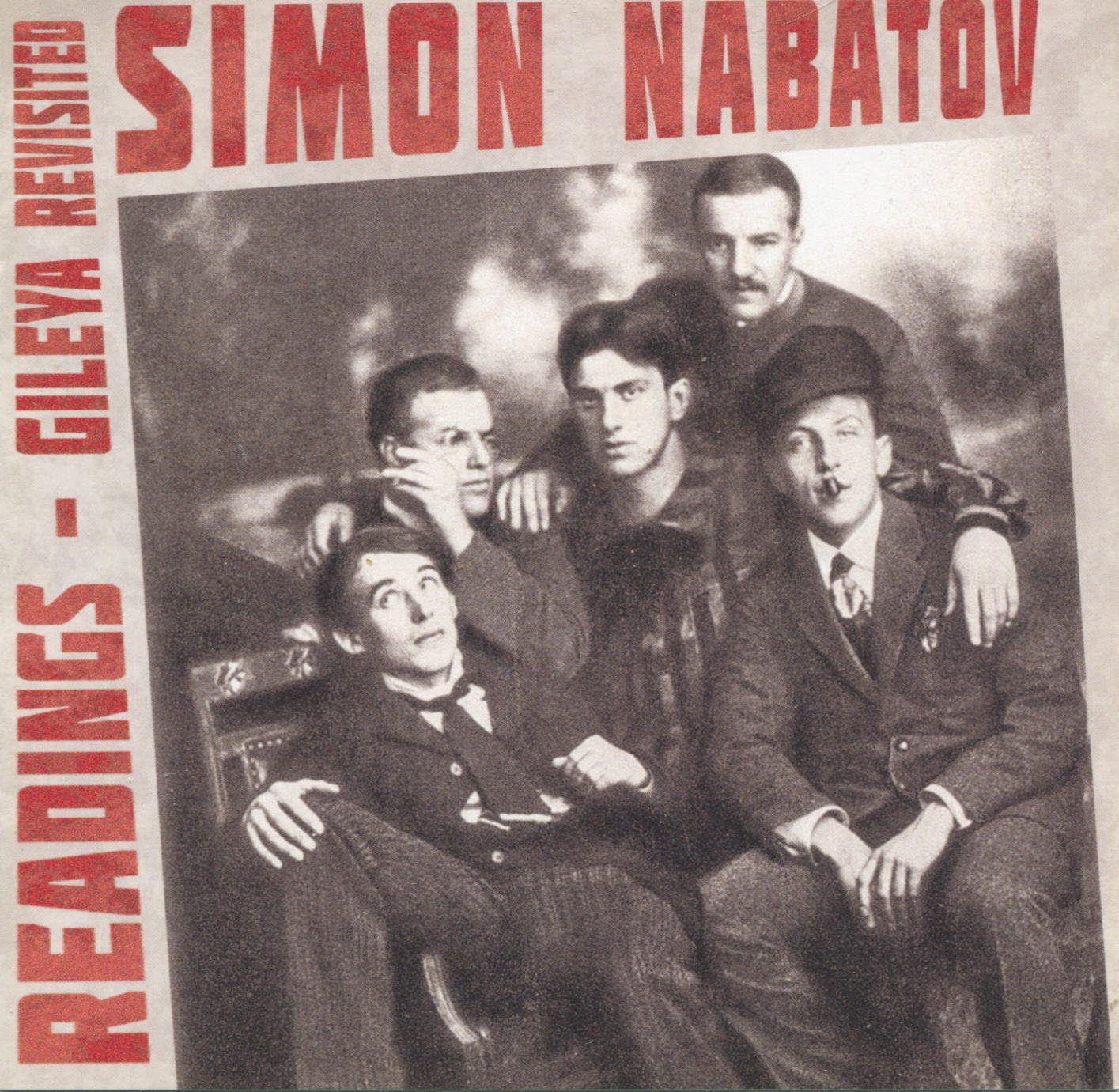
A particularly fascinating instance of this is Readings Gileya Revisited (Leo CD LR 856). On it Russian-born, Cologne-based pianist Simon Nabatov has created musical settings for poems from members of the Gilya group, a Russian futurist movement that thrived just before and for a time after the Russian Revolution. The pianist’s associates are Germans, reedist Frank Gratkowski and electronics master Marcus Schmickler, American drummer Gerry Hemingway and most importantly Dutch vocalist Jaap Blonk. While Schmickler’s skills are used sparingly, as on the penultimate track where granular synthesis and processing deconstruct a sample of one of the original Futurist’s recitations, then superseded by resounding pattering from the drummer. In another instance on “A Kiss in the Frost” oscillated aviary echoes share space with Blonk’s double-tracked theatrical recitation of a Futurist poem, completed by reed buzzes and piano patterns. But the nub of creativity is most thoroughly expressed in the ways in which Blonk’s phrases plus piano-reed-and-percussion sounds interact as equals. For instance the gargles and yells that express the budding in “Spring” are met by hard keyboard comping and drum pops following an introduction of ethereal flute puffs. Imagist stanzas that warble and plead are extended with reed bites and press rolls on “And Could You”, while harmonized keyboard tinkles and formalistic clarinet trills do as much to define the theme of “Palindrome” as matched nonsense syllables from Blonk. Most crucially, with the boisterous dynamics which characterize “Shokretyts”, composer Nabatov and the others confirm that futurism is as much an instrumental as vocal art. After Blok intones “when people die they sing songs”, Gratkowski’s tenor saxophone response is almost (Stan) Getzian in its lyricism, although it’s followed by dynamic key crunches and sprays of notes from the pianist, bass drum pounding and wild-boar-like snorts and altissimo screams from the saxophonist until all four shout out the track title. As the players’ instruments replicate the syllables Blonk intones them to complete the poem.
Ken Waxman
situations
Jazzword
The continuation on Situations is to the still-extant compositional heritage, but more nuanced since it’s mixed with improvisation and is firmly in the post-modern tradition. Nabatov’s flowing arpeggios reflect the Romantic mores, while the sul pontucello whistles and drags on their instruments’ strings from Davis and Lubbe reflect a more angular modernism. Two-thirds of the way through the introductory “Unfold-Fold” all three lines overlap to create a perfect pseudo-chamber étude with ingenious harmonic overtones that unravel the theme once again with high-frequency keyboard syncopation and spiccato pushes from the eight strings.
From that point on the five remaining suite sequences move continuously from polyphonic Rite of Spring-like turbulence with splayed and rasping string motifs plus high energy keyboard pounding. Elsewhere, as on “Stern Looks”, the interface is reversed with Nabatov’s chording metronome-like and percussively as Davis and Lubbe unite for unfolding, whining pseudo-romantic surges. Moving among the piano’s waterfall harmonies or focused key picks and pecks are cello and viola motifs that encompass flying spiccato and jerky string splats at one extreme to gentle pulls at the other.
Widened through tremolo string stopping and powerful piano glissandi, the climatic “Meta Morph” ends the suite with a binding of variable tones from all three, String sweeps and contrasting dynamics from the piano allay the kinetic sequence into a moderato regularized ending.
Nabatov’s talents allow him to not neglect his so-called classical training when involved in free-form improvisation as on the Japanese-recorded CD; or add the freedom of pure improvisation to more formal strictures as on the German-created one. Both paths are equally notable as are these CDs.
–Ken Waxman
2017
mirthful myths
Jazz Weekly May 2017
Frank Gratkowski brings alto sax, clarinet and bass clarinet to team up with Simon Nabatov’s piano on six pieces of intimate improvisation. On bass clarinet, there are dreamy and noir moments on “At The Beginning” while he huffs and puffs to piano keys and strings being popped on ”Three Tamed Furies.” Nabatov uses his string again, this time like a banjo while Gratkowski whirls around like bees on “Eirene All Around” while the pianist pounds on a stark and aggressive “Cloud Gatherer Awakes.” Lots of intuition, sometimes swirling in your head and other times reaching your viscera.
George Harris
The New York City Jazz Record May 2017
...Gratkowski and Nabatov play even more atonally on Mirthful Myths, the latter using inner piano string plucks and vibrations as often as sweeping Cecil Taylor-like keyboard dynamics while the former spills unexpected sharp timbres onto the narrative as frequently as he blends with the accompaniment. The introductory “Three Tamed Furies” is the only misstep. Moving from somber to spirited, both devote too much time to brazen extended techniques only reaching a satisfying pas de deux of jittery pianism and sighing trills at the finale. More notable are the five subsequent tunes, where one overriding motif is tried out for size, examined every which way like a stone under a jeweler’s loupe and leads to the next sequence. “Progress of Notus” is a lesson in keyboard control, as Nabatov rolls textures from inner strings at a crawling tempo, eventually blending with Gratkowski’s measured note cascades. “Eirene All Around” turns string scrubbing and reed splutters into vibrant storytelling while “Cloud Gatherer Awakes” reflects how intense piano multiphonics and sharp reed bites can be inveigled into a squiggly tune that swings enough to make one yearn for its extension....
Ken Waxman
monk ‘n’ more
Jazzword
With many Monk compositions now nearly 70 years old, they’re as much Classic Jazz as Morton tunes. On Monk ’n’ More (Leo Records CD LR 780), Russian-American pianist Simon Nabatov tries for a similar alchemical updating of five Monk lines by interspacing them among five originals that probe keyboard extensions using live electronics., Nabatov no more takes the Monk canon as immutable, than a Talmudist would take the Torah’s words as unavailable for interpretation. Like that scholar’s theories, Nabatov’s explorations provide alternative readings of the pieces. Nabatov’s take on “Skippy” for instance is more herky-jerky than the original; while “Oska T” is taken thicker and faster. Using pedal shading he adds echoes of the Russian romantic tradition, while paradoxically emphasizing the tune’s swinging pulse that in turn links it to the blues and stride Morton and Ellington were perfecting in the 1920s and 1930s. Re-harmonized, “Pannonica” becomes more expansive, with the triplet timed note coloration adding unexpected tenderness to its habitual angularity. Although most of the electronic experiments are concerned with laboratory condition-like probes into pitch and timbral extensions, the additional clanging results confirm Monk’s unique orientation. The discontinuous interface on “Electronic Extension 4” for example with its blurry pulses reflecting back onto the initial stop-and-start theme posits how Monk could have utilized computer programming. This is confirmed on “Sunrise Twice Redux” the CD’s almost 14½-minute centrepiece. < Gathering these strands together to revamp existing parts of the jazz canon is Nabatov’s contribution to examining classic music from new angles. All the CDs are instances of how intermingling new ideas and older themes rejuvenates venerable material.
–Ken Waxman
picking order
Jazzword
Like a scholar still seeking more and diverse knowledge as he gets older, pianist Simon Nabatov, 57, keeps evolving musically without neglecting his earlier concepts. The Russian-born, long-time resident of Köln, Germany, who started his career in New York in 1979, doesn’t shy away from any challenges or configurations, whether playing solo piano or part of ensembles. Picking Order is a trio date with German bassist Stefan Schönegg and Swiss drummer Dominik Mahnig. Although Nabatov has frequently recorded in the latter format, this is his initial outing with Schönegg and Mahnig, both of whom are about three decades younger than him.
This doesn’t mean that the seven tracks on the trio disc suggest the idea of a pack leader giving instruction to young pups. Instead the drummer’s hard smacks and the bassist’s centred thumps add as much to the interaction as Nabatov’s playing, which within instances can ricochet from dynamic Cecil Taylor-like emphasis to neo-classical waterfall-like note spurting. This is especially obvious on “Fill in the Blanks”, the introductory and longest track in this session recorded at Köln’s the Loft, and a location as associated with Nabatov as the Five Spot was with Thelonious Monk. Comparisons to Monk are apt. Never as quirky in his playing as the American icon, the classically trained pianist similarly retains links to the tradition and can be as lyrical and balladic in spots when he wishes. Elsewhere he’s up for any single note challenge, rhythmically or chordally, and on this track emphasises both roles: with a delicate lyrical bent to the tune’s first coda, toughening it with emphasized thumps second time around.
Lighter and darker the Jekyll and Hyde sides of Nabatov’s piano persona are displayed throughout the rest of the disc. A track such as “It’s a Given” gives a demonstration of his keyboard command for instance. Starting slowly like a sprinter preparing for a race, his romantic key sprinkles soon give way to Olympic-Game-level key clashes and cascades, where Earl Hines-like utilizing of notes and patterns crop up alongside unlimited atonal expanses. However like Jaki Byard or Monk, he never loses the swing element.
Mahnig’s rumble and pop coupled with Schönegg’s walking bass line on “Turning Point” as well as the bassist’s string buzzing introduction to the sardonically titled “Growing a Soul Patch” set up animated swing parameters that almost move the trio via the Wayback Machine to 1950s-1960s-style pop Jazz. Still Nabatov’s sophisticated investigation of theme variations on the first tune and plunge into impressionism on the second ground the program in 21st Century post-modern improvisation.
–Ken Waxman